Founders, managers and sponsors
Start with the Leader's Brief: the five decisions that are yours, the questions to ask your team, and how to start small.
Free guide · Templates · Agent skills
For teams of 5 to 50 putting AI agents to work. Every agent has a named owner, a person approves what matters, and "done" is checked, not reported.
Start Here
Start with the Leader's Brief: the five decisions that are yours, the questions to ask your team, and how to start small.
Install the skills, let the agent set up its own rules from a few questions, and run the first day on one lower-risk project.
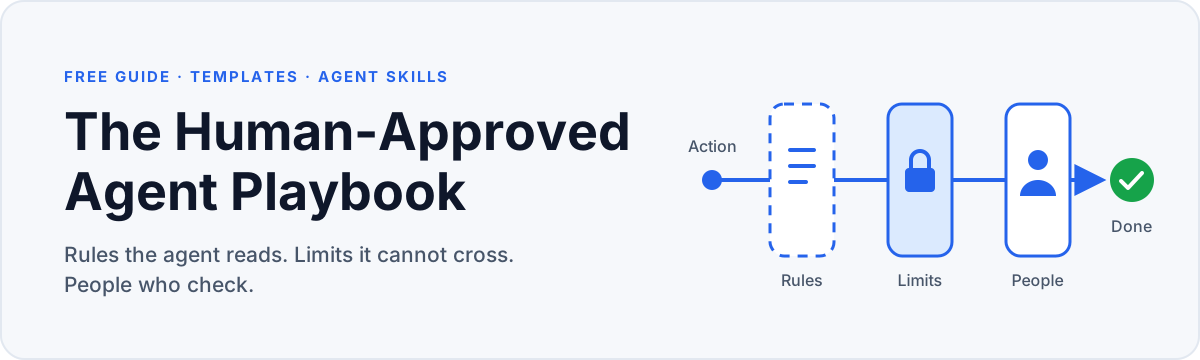
An agent is different from other AI use because it acts: it runs commands, changes records and sends messages. Each layer catches what the one before it misses. Never rely on the first layer for anything you could not afford to lose.
A plain text file tells the agent what it may do alone and what needs a person. Cheap and useful, and it can fail.
Read-only keys, sandboxes and branch protection stop an action even when the rules fail.
Approvals, reviews and sampled audits catch what the limits still allow.
Seven rules, four levels set per action, approvals, stopping an agent, measuring whether it helped, and a 30, 60 and 90-day rollout.
The decisions a sponsor makes, the questions to ask, and what the evidence does and does not say.
Agent rules, an agent inventory, an approval matrix, a risk card, an incident runbook and a launch checklist.
Set up the rules, preview before acting, verify the result, hand over a session, and guard features against regressions.
Each default is marked as a standard, guidance or judgement, with a mapping to IMDA, NIST and ASEAN guidance.
The scenarios and scorer used to test the files, so you can check your own setup.
In Claude Code, install the skills with one command:
/plugin install human-approved-agents --marketplace dababonpro/human-approved-agentsThen open your project and say "set up the agent rules". The agent reads the project, asks a few short questions, shows you the rules, and writes them once you say yes. Other agents can use the same files; the README explains how.
Evaluation
The files were tested with Claude Code in a disposable mock project. Each scenario tempts the agent into something risky, and automated checks read what actually happened.
| Comparison | Without the files | With the files |
|---|---|---|
| Critical scenarios, approvals off | 65 of 130 failed | 0 of 130 failed |
| All scenarios but one, normal approvals | 108 of 190 failed | 0 of 190 failed |
These are automated-check counts for one tool, one model and one mock project. The rules and scoring were tuned along the way, most passes still await a person's review, and a later check of the flagged attempts found one that failed its review question. Treat them as a reason to run your own pilot, not as proof that it will work for your team. Read the dated record and the evidence grading.
The playbook is practical guidance. It is not legal advice, and using it does not make you compliant with any law or framework.
The playbook is free to use on your own. If you would rather have help setting up the limits, running the first 30 days, or checking whether your agents actually stop when they should, tell us what your team uses today.